2025-07-16

HOY ES LA VIRGEN DEL CARMEN PATRONA DE LOS HOMBRES DE LA MAR

 A LA VIRGEN DEL CARMEN QUIERO Y ADORO PORQUE SACA LAS ALMAS DEL PURGATORIO (CANCIOCILLA)

LA VIRGEN DEL CARMEN ME COMPRA UNA BICICLETA


Hoy por ser la virgen del carmen me compro una bicicleta. Setenta euros, de piñón fijo, nada de cambios ni de juego de platos, el derraller es de piñón fijo y por los caminos de tierra de las dos mochas voy cantando aquello de a la virgen del carmen quiero y adoro porque saca las almas del purgatorio. Hoy según roma ya no hay purgatorio pero uno sigue creyendo como dios manda en lo que hay que creer. Hermosa mañana de julio cuando salgo al campo después de desayunar y de encender mi primera cachimba. Me dice la parienta que a lo mejor hoy somos abuelos. Al lado del camino hay una cosechadora que deja atrás las trojes. Ya no se espiga, ya no se siega, ya no se bielda. Viene una máquina y en un par de horas realiza la labor que cuando yo era niño costaban tres meses de sudores casi desde san pedro hasta san miguel cuando eran ajustados los gallegos y los agosteros. El gruista se sienta dentro de una cabina con aire acondicionado.¡ Hostias! Le digo buenos días pero no me oye. Está escuchando a Herrera en la Onda. Los labriegos se han vuelto muy señoritos. Ya no hay que levantarse a las tres de la mañana para ir a arrancar yeros, ni descabezar con el bamboleo del carro un sueño hasta llegar a la obreriza, ni clavarse las espinas de los cardos ni ponerse en la mano izquierda la clásica zoqueta detergente contra las cortaduras de la hoz. Ya digo en una mañana se avía. La máquina carga los costales automáticamente y pal silo. Sin embargo, en esos viejos campos del noroeste de Madrid he visto menguar los labrantíos. El ladrillo ha sido el responsable de que los buenos trigales de muchas obradas se hayan convertido en casas, urbanizaciones, chalés para los nuevos ricos. Cada vez que paso por alguna de estos rastrojos donde hay bandas de perdices atiborrándose de grano muy selecto me pregunto si no será esta última la última cosecha. A lo largo de casi veinte años que ando por estos rumbos en mi bicicleta he visto convertirse en solares y edificios buenos terrenos labrantíos. Me da un poco de pena porque al año que viene no cacareará la perdiz por los rastrojos. Hace un sol radiante. Cerca del río Guadarrama hay un rodal de ailantos, bajo cuya sombra me tumbo en una peña, saco mi breviario y rezo las horas, laudes nona, prima y sexta, y luego viene el rosario en honor de la Virgen del Carmelo. Los marineros sintieron hacia Ella una gran devoción. Hoy es fiesta con voladores en Luarca y habrá mucho jolgorio en Pola de Siero. De la Virgen de julio a la Virgen de agosto. Toda España es una fiesta. Hoy me siento el rey del mambo en este ambiente soledoso lejos del bullicio de Madrid y de las villanuevas. Con mi bicicleta nueva que es un poco antigua me siento el rey del mambo, ahí me las den todas. Mi bici es de piñón fijo. De piñón fijo como yo, nada de mariconadas, hay que ir de a hecho. No cambiar de plato, no variar el rumbo de las ideas, amar lo que siempre se amó y aborrecer lo que te enseñaron de niño que no está bien. Sube muy bien las cuestas y las baja aun mejor. A la hora de comer ya estoy de vuelta. Para subir cuestas arriba quiero mi mulo que las de abajo yo me las subo


"Дороги" Дмитрий Хворостовский (4.2003) LUCE ESTRELLA LUCE CON FUERZA

Всенощное бдение 16 июля 2025 года, Храм-на-Крови, г. Екатеринбург

A TAL PÉRDIDA TAN TRISTE - Juan del Encina (1468 - 1529) EN LA MUERTE DEL PRINCIPE DON JUAN EL UNICO HIJO VARÓN DE LOS REYES CATÓLICOS

2025-07-15


PASCUA DE SAN PEDRO

Celebramos san pedro y san pablo once días después. Resplandecieron las dalmáticas y el Espíritu Santo estaba arriba en el sabaoth en cuyas proporciones reverberaba, milagro de la ortofonía, la voz del diácono.

 El patriarca, hecha la genuflexión, salió a bendecir por la puerta de los dones y alguno de los fieles presentes carismáticos pudo divisar las barbas del Altísimo. 

Dios Padre se pasea encaramado en lo más alto de la bóveda de luneto. Una golondrina cruzó rauda los ánditos y por el portal de atrás se escapó. Bendito seas, Señor, que te manifiestas a los humildes y desdeñas al poderoso y triunfador. Porque el diablo seguía jugando a las cartas en Kiev y en Washingtón. Ton. Ton.

 De allí llegaban gritos y amenazas que conminaban a los pobres españoles que no entendían nada a pagar las guerras del amo gringo norteamericano.

El Zanahorio del bisoñé triunfal era muy cínico y muy suyo. Os lo vamos a hacerlo comer con patatas y hubo revueltas por las riberas del río Tajo. Que te lo crees tú. Pero un holandés risitas y con cara de yesman adulador le sostenía al déspota el sillico mientras meaba, Donald tú andas mal de la próstata.

El otatonto el que cambiaba el agua al canario llamase Rute y es un maldito holandés enemigo de España criado a los pechos de la gran sinagoga de Ansterdam.

 Pese a los nubarrones de la política internacional, por estos tesos, sin novedad en el frente.

El personal hacía las maletas para irse de vacaciones. La luz del sol brillaba más que otros años y los expertos erre que erre seguían especulando sobre los riesgos del cambio climático que traerá a la tierra un deshielo general cuando se derritan los polos. Pero los campos estaban hermosos. Decían los campesinos:

─Este año de avena, cebada y trigo habrá un cosechón.

En Torrepacheco se lió la de dios es cristo entre moros y cristianos. Los judíos no los moros, son los incitadores, están detrás (a mí me parece) de estos disturbios y del cambio climático.

Desde la guerra de los seis días no hacen otra cosa que conspirar. La madre del cordero de las inmigraciones masivas y del terror del milenario estaba en el sanedrín de Washington.

 Aunque nos acusen de conspiranoicos diremos que esa gentuza vive de hacer la guerra de arruinar países y de poner hermano contra hermano como en Palestina y en Ucrania. Puesto que son  duchos en tirar la piedra y esconder la mano.

Por lo que a mí respecta yo ya no yago en mi mazmorra. Vino el gran Eleuterio el día de Pentecostés y quebrantó las cadenas que me amarraban al foso de los leones. Escapé aprovechando el momento en el cual el Carcelero de la Venganza salió fuera de la Cárcel  a echar un cigarro.

Por eso me encuentro a la sombra pero de un lugar más benigno e idílico que aquel presidio al cual fui conducido tras una denuncia falsa. Es la sombra del Monte Pinariego no la sombra del Hacho.

Percibo desde mi celda monacal el arrullo de las olas al romper contra los recifes y si me asomo al ventanuco veré a bañistas o a corredores calistenia que hacen futin, la vida es un maratón, sobre la arena blanca del estero.

Las cornejas siguen empollando un runrún que no para en todo el día sus huevos sobre la quima del viejo carvallo del jardín central. Ya va para dos años que me operaron de cáncer de próstata y a mis ochenta y un años estoy hecho un chaval y con ganas de dar guerra aunque me cuesta mucho trabajo escribir una novela en la cual el protagonista y deuteragonista soy yo, porque en la vida me ha gustado siempre ser Juan Palomo. Yo me lo guiso yo me lo como.

miércoles, 16 de julio de 2025

2025-07-13

Adoro Te Devote

Joaquín Díaz interpreta "El enamorado y la muerte"

AY LUNA QUE RELUZES (Anónimo) - Cancionero de Uppsala (S. XVI)

LEVANTA, PASCUAL, LEVANTA - Juan del Encina (1468 - 1529)

Juan del Encina "¿Qu'es de ti, desconsolado?"

TRISTE ESPAÑA SIN VENTURA - Juan del Encina (1468 - 1529)

Tomas Luis de Victoria - Ave Maria

Misa católica histórica en la Catedral Anglicana de Canterbury

2025-07-12

Russian Orthodox Sacred Music

CONDENEMOS La fornicacion que vuelve al hombre y la mujer animales presas del instinto


Guard Your Heart Against Lust

The Eight Deadly Sins and the Fight Against Them, Part 6B

Part 1
Part 2
Part 3
Part 4
Part 5

Part 6A

Photo: uznayvse.ruPhoto: uznayvse.ru    

Where does the sin of fornication begin? Whosoever looketh on a woman to lust after her hath committed adultery with her already in his heart (Mt. 5:28). This is where the passion starts. A man allows it into his heart, enjoys it, and from there it’s not a long way to physical sin.

Yes, sin proceeds from the heart, but it also somehow gets into the heart. It comes from several sources. Lust, as the Holy Fathers say, is directly connected with the sin we spoke about in the previous article—the passion of gluttony, of bodily satiation and winebibbing. “Abstinence begets chastity, but gluttony is the mother of fornication.”1 Let us also recall: And be not drunk with wine, wherein is excess [debauchery] (Eph. 5:18). Love of eating is a carnal passion, which can be curbed by accustoming the flesh to abstinence and moderation. Fatty, rich, spicy food, winebibbing—all of this inflames the blood, triggers hormonal activity, and excites. This is a well-known fact.

Another factor influencing the violence of the flesh is when we fail to guard our vision and other senses. Of course, we haven’t yet reached the monstrous debauchery that Ancient Rome drowned in, although we’re getting closer. But Rome certainly didn’t know such propaganda and advertising of this sin. Much was already said about this in the article about the mass media. Not only the TV (which can at least be turned off) but also the streets of our cities are filled with images of exposed bodies. Moreover, shameless billboards sometimes “decorate” the busiest highways. I think the accident rate near such billboards is several times higher. Once there was a Moscow priest who couldn’t take it any longer, so he took a big ladder and wrote on a huge obscene billboard in black paint: “Luzhkov, are you the mayor of Sodom?”2 Of course, all this is done to corrupt and weaken the nation. It’s a well-known fact that Hitler distributed pornography and contraceptives in occupied territories. Meanwhile, in Germany itself, pornography was prohibited.

Is it possible to protect ourselves from all this filth that literally stalks us at every turn? It’s difficult, but it’s possible. The Lord doesn’t give us trials beyond our strength. And the man who wants to preserve his soul and body in purity can do so even in Sodom, like Righteous Lot.

The first thing to do is to reduce the sources of temptation to a minimum. Second is to not fixate on provocative things, not get attached to them. Don’t devour seductive images with your eyes, but learn to glide over them as if not even noticing them.

And the third thing is not only not to pay particular attention to temptations, but also to change your attitude towards them, to perceive them as something neutral. Here’s an example to explain what I mean. Although I have fairly extensive experience driving, I still suffer from inattentiveness and absent-mindedness on the road. I can get distracted along the way by something interesting or unusual, and this has let me down more than once. So I came up with a rule and made a vow to myself that when I’m behind the wheel I’ll only watch the traffic conditions, road signs, the dashboard, and not fix my gaze on anything else, anything distracting, but let my gaze glide over them, not lingering on them for very long. This technique also helps us guard our vision in normal life, not on the road. When you encounter something unhelpful that causes temptation, you can’t help but see it (although it’s useful to look away), but you can avoid examining it or letting your gaze linger on it. Of course, this requires a certain skill. But afterward, you begin to automatically filter out what you shouldn’t be looking at.

Another important way to protect yourself from temptations is to change your attitude towards tempting things. Things themselves are neutral—what makes them good or bad is our attitude towards them. For example, you can look at a woman as an object of lust (even if she’s dressed very modestly) or as something neutral. St. Theophan the Recluse writes about this: “What can you do if, living in society, it’s impossible not to look at women? But it’s not simply looking at a woman that constitutes adultery, but looking with desire. Look if you must, but keep your heart on a leash. Look with the eyes of children, who look at women purely, without wicked thoughts.”

We can look at someone of the opposite sex as a sister or mother (or brother or father), but not as something that inflames lust within us. After all, very often we’re ready to open our soul to passion. But if it’s locked, it will be difficult for a tempting image to penetrate within. If a man has a wife, only one woman can exist for him—his spouse. He must love only her as a woman—all others have no sex. He should see only what’s human in other women, not what’s feminine. The enemy is very powerful, and it’s only one step from an immodest look, from light flirtation, to adultery. We have to preserve not only our eyes but also our mind in purity. Impure, lustful thoughts are like dirt, sullying and defiling our heart and soul. It’s for good reason that St. Ephraim the Syrian called the demon of lust the “demon of impurity.” We’ve already discussed in one of the previous articles how to fight against sinful impure thoughts.

Everything said above relates to thoughts, feelings, desires—this is where the passion of lust begins. The second thing we have to keep in mind is our behavior. Woe to that man by whom the offence [temptation] cometh! (Mt. 18:7). Immodest clothes, double entendres, casual behavior with the opposite sex—all of this can harm not only ourselves but others as well. And then “woe to us.” Whatever we do, we must always think about whether we’re being unconsciously driven by some passion and how our behavior will resonate in the heart of another.

Woe to the World Because of Temptations

Many things in our lives depend on our attitude to a particular problem. Even obvious temptation can be treated quite neutrally. But if we deliberately attune ourselves and fuel passion within ourselves, it takes only a small push for the passions to break loose from their chains.

Nowadays, the mass media, modern literature, art, even education try to indoctrinate us with the thought that sin is the norm and black is white. The sin of lust is especially strongly promoted: “Sexual life is necessary for everyone without exception (in various forms); you simply can’t live without it; without it, you’ll never have happiness, health, or anything at all. If a person has sexual organs, they should be active, etc.” We could talk about this for a very long time, but it’s all clear. Everything has been turned upside down: Sin and perversion aren’t something to get away from, but something we can’t live without. The source of all this is known too. We’re being offered a monstrous lie, and the father of lies is the devil, as we know.

Is it possible, living in this terrible world of debauchery and sin, to maintain purity?

The Gospel, the New Testament, where fornication is called a mortal sin, wasn’t written only for people of the first century. It’s written for all times and for us, Christians of the twenty-first century. Where did the first Christians live? In the Roman Empire. Rome reached a level of licentiousness, debauchery, and sexual perversion that our country hasn’t yet reached, thank God. Nevertheless, Christians were able to save themselves and their families from the onslaught of impurity. And Christianity, despite the most severe persecution, was able to change this world. In the beginning of the fourth century, the empire became Christian.

If we talk not about the time of the first Christians, but about our recent past, then just twenty years ago much of what modern youth consider funny, absurd, and outdated was the norm. Starting a family was a mandatory norm. For most girls, it was the norm to save themselves until marriage. Cohabitation without marriage was condemned by society and was extremely rare. This was the case in our country, where family traditions didn’t die even in the godless Soviet times. And in general, any normal man sooner or later understands that the path of licentiousness, permissiveness, and family destruction is a path to nowhere. America, exhausted by the fruits of the “sexual revolution,” has turned towards moral, family values. In 1996, a program was introduced in the U.S. called Abstinence Education. It’s allocated $50 million a year. It’s goal is to counter sexual promiscuity, abortion, and extramarital pregnancy by promoting abstinence and explaining to teenagers that it doesn’t harm the body.3

Unfortunately, in our country, on the contrary, many tactics are being used to instill in us the view that abstinence is harmful: “If there are organs, they must be used at all costs. If there’s a desire, it must be satisfied.” And therefore we’ve surpassed everyone in abortions and the number of abandoned children.

A little bit about the reproductive organs: They’re given to us for reproduction, for producing offspring, and all animals use them for this purpose. It’s not bad for our health when they’re not used. For example, a woman could give birth to one child her whole life, or even not give birth at all. In this case, her uterus remains unused, but that doesn’t mean she gets sick. The human body has built-in self-regulation mechanisms.

Everything depends on our attitude to the issue of abstinence. If a man convinces himself that he can’t live without sexual relations, it will really be impossible for him to abstain. But those who are attuned to abstention, to keeping themselves from temptations, are able to bear it.

It’s also necessary to learn abstinence in marriage. After all, there are fasts, periods of pregnancy, and there can be illnesses. There are people whose jobs involve long business trips. It’s always been this way, and spouses somehow reconciled themselves to it and endured it. Many pious mothers had many children, and during pregnancy and the period of breastfeeding (which is more than two years) had no carnal relations with their husbands.

And now even some doctors recommend treating certain diseases (such as prostatitis) through casual relationships. If a man doesn’t have a wife, they advise him to get a mistress for “healing.” What can be said about this? Prostatitis isn’t a new disease. But in our time, immorality and promiscuity have captured all layers of society and all classes, including doctors. No sin can be the foundation of treatment. Sin doesn’t build up—it only destroys. There are many modern medications and treatment methods for male diseases now. Unscrupulous doctors sometimes give simply terrible advice. One man lost his only child, who was very ill and died in his arms. This man was extremely grieved. Moreover, his wife could no longer bear children. He underwent treatment for a long time, consulted psychiatrists and psychotherapists, and this is what they advised him: “Get yourself a mistress and let her bear you a child. Or divorce your wife and marry a young woman, then you’ll have children.” Yes, truly “terrible age, terrible hearts!”4

God Help Us!

The battle with the burning of the flesh is a natural thing—no need to be afraid of it. Every man feels certain impulses and movements in his body. But these movements shouldn’t get out of control. Our hormones, our nature, must always be kept on a short leash and in a tight collar, otherwise this dog will break free and may bite us.

If we want to fight the lust of the flesh and entreat God’s help, the Lord will certainly help us. If there’s no struggle with the flesh, there will be no reward for your labors.

There was a certain Fr. Konon who often celebrated the Sacrament of Baptism. Whenever he had to anoint women with holy oil and baptize them, he was greatly disturbed and it made him even want to leave the monastery. Then St. John the Baptist appeared to him and said: “Be strong and patient and I’ll deliver you from this battle.” One day, a Persian girl came to him for Baptism. She was so beautiful that the priest didn’t dare anoint her with the holy oil. She waited two days. Meanwhile, Fr. Konon took his mantia and departed, saying: “I can’t stay here any longer.” But as soon as he reached the hill, St. John the Forerunner met him and said: “Return to the monastery and I’ll deliver you from this battle.” Fr. Konon angrily replied to him: “Make no mistake, I won’t go back for anything. You promised me this more than once but you haven’t fulfilled your promise.” Then St. John opened his robes and made the Sign of the Cross three times. “Believe me, Konon,” said the Baptist, “I wanted you to receive a reward for this struggle, but since you didn’t want to, I’ll deliver you, but you’ll lose the reward for your labor.” He returned to the monastery and baptized the Persian girl as if not even noticing that she was a woman. After that and until his very death, he celebrated Baptisms without any impure arousal of the flesh.

It’s no accident that carnal lust is compared with fire, with flames. The Holy Fathers unanimously say we mustn’t give it any food (fuel) through satiation of the flesh, our eyes, ears, and other senses, and then it won’t be difficult to deal with it. Suddenly ignited flames can easily be stamped out, but in just a few minutes an entire house can be set ablaze. Anyone who has ever seen a big fire knows how uncontrollable the fiery element is.

Archpriest Pavel Gumerov
Translation by Jesse Dominick

Pravoslavie.ru

5/26/2025

1 St. Nilus of Sinai, Philokalia vol. 2 (Russian), On the Eight Spirits of Evil. This text is also sometimes attributed to Evagrius Ponticus.—Trans.

2 Yuri Luzhkov was the mayor of Moscow from 1992 to 2010.—Trans.

3 Of course, America has changed a lot in the interim.—Trans.

4 A quote from Alexander Pushkin’s historical drama “Boris Godunov”—Trans.

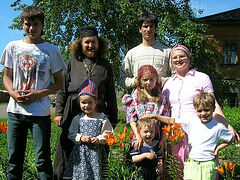
LA BELLA FAMILIA DE JOVENES PRESBITEROS RUSOS. LA IGLESIA CATOLICA DEBERIA APRENDER


How to Start a Family, Once and For All

On July 8, Russia celebrates the Day of Family, Love, and Fidelity. This national holiday is timed to coincide with the feast day of Sts. Peter and Febronia of Murom, Orthodox patron saints of marriage and family life.

We spoke with Priest Georgy Firsov, a cleric of the Church of the Dormition of the Most Holy Theotokos in Veshnyaki (Moscow) about the secret of a happy marriage.

Father Georgy is deeply involved in working with young people in his parish, helping them make the right choices and build truly strong families.


—Father Georgy, one of the main problems of modern families, it seems to me, is that people rush into registry office. They confuse love with infatuation, romantic feelings with the desire to build a family on Christian foundations. In your opinion, how much time should pass before a couple gets married? Sometimes people marry two months after meeting, barely knowing each other—and then the problems begin.

—Yes, you’re absolutely right. People start families far too quickly. I know several such families, and unfortunately, that kind of haste doesn’t always end well. On the other hand, there’s the opposite problem—people date for three or four years and still don’t get married. In reality, a couple should date for at least a year, no less. It’s good if they have some shared activity. For example, my wife and I met while feeding the homeless at a train station. It’s important to see how a person behaves in certain life situations.

—Where should people meet? On the one hand, the internet is where most connections happen nowadays. On the other hand, the internet is always a gamble…

—I think it depends on the person. God arranges things in the way that will benefit each one. What matters isn’t how you meet. Of course, it should be in decent places. What’s important is your goal—do you seriously want to build a family, what are your desires and expectations of a future spouse, and so on. I know of a case where a priest friend of mine met his future matushka online—they’ve now been happily married for five years. People meet in all different ways.

—Psychologists say that the faster you move from virtual to real life, the more likely you are to truly understand who the person is. Online, we all wear masks…

—For many people, social media is a monument to vanity. You try to present yourself as someone you’re not. Some post pious quotes, Orthodox content, decent photos, write nice things about themselves—but in real life, that same person may behave completely differently or hide things. So you shouldn’t fully trust what’s on someone’s profile. The sooner you meet in person, the sooner you’ll understand who they really are—and whether it’s worth continuing to communicate, let alone share your life.

—For Orthodox Christians, it seems best to meet within their parish community. But what if your future spouse is not living the church life? What’s your view on such marriages?

—With the young people in our parish who want to start a family, we talk about reasons why one should avoid marrying certain individuals. First of all, it’s about marrying outside the faith. Yes, I know of cases where non-Orthodox spouses have a respectful attitude toward Orthodoxy—they allow their wives to practice the faith, baptize the children, bless the home. But there are also opposite situations—when such things are not allowed. It’s hard to walk through life together when your faith is different—though, again, there are exceptions.

Also, one shouldn’t marry someone with addictions. If you see that the person is an alcoholic, drug addict, gambling addict, has deviant behavior, or lacks self-control, then it’s probably best not to build a family with him.

In addition, I don’t advise my parishioners to marry someone who is divorced. According to Scripture, whosoever shall marry her that is divorced committeth adultery (Matthew 5:32). That person may be kind, good, even a churchgoer—but they’ve already experienced a shipwreck. Sadly, I often see that second marriages lead to nothing good. The person promises to forget the past, but in a second marriage, they repeat the same mistakes.

For a woman who wants to marry, I would name three desirable qualities in a man. First: that the man loves and respects you. Without that, it’s simply impossible to build a marriage. I see no reason to marry a man who humiliates you in front of others, doesn’t love you, or shows that in some way. Without love, there’s no sense in entering marriage.

Second: a desire to have children. If a man says he loves you but isn’t ready for children, then it may turn out that he never wanted them in the first place.

And the third point for a woman entering marriage is that the man should have the desire to provide for the family. You should be concerned if your beloved says he loves you and would give you the stars, but has trouble holding down a job, doesn’t know who he is or what he wants to do for work, and generally prefers to lie down than to work. A man is someone who might be a factory director, but if times are hard, he’s willing to get behind the wheel and drive a taxi so the family won’t go hungry. A man is someone his family—and especially his wife—can rely on. A woman needs protection, stability, and some comfort in order to thrive as a woman. A man must fulfill all these roles.


—One of the pressing problems in modern society is the infantilism of men and the masculinity of women. The redistribution of gender roles often ends in divorce.

—Not always. Sometimes the man simply agrees to live that way—with a “heel-shaped hole in his forehead.”1

—Then he must be comfortable in that marriage if he accepts it. Or why else would he do it? Out of laziness? What is he trying to achieve?

—A man cannot truly be comfortable in a marriage where the woman is the leader. He may pretend; he may feel comfortable from a purely financial or physiological standpoint. There are situations where the wife earns millions, gives her husband a car for his birthday, and he stays home with the kids. But often it ends with the man leaving—for a place where he’s made to understand that he needs to become a man.

For a woman to become a man—or vice versa—is unnatural. And everything unnatural is against God. When a woman stops relying on her husband, she starts to build her own comfort and security. Then she not only attempts to change her spiritual role—she even undergoes physical changes. She may still have styled hair and a manicure, but gradually she begins to resemble a man. Surely you’ve seen such women—stern businesswomen. When she walks into a room, all the men fall silent and listen attentively to what she says.

—Can a woman change?

—You know, it’s always mutual. If a man has the desire and courage to change the situation—and the woman is willing—then anything can be restored in a family. You can come out of any pit, any stress, any family crisis. I know cases where it seemed absolutely impossible to save the marriage, but the people tried, made an effort—and now they’re still together.

—So mutual desire is key?

—Who is a man, fundamentally? First of all, he is someone responsible, someone who builds. For a woman, a man is a leader—not just someone who has an idea and wants to fulfill it, but someone who needs others to believe in his idea and follow him.

Yes, a woman can change. I’ve seen it happen—when a woman sees that a man is making a real effort, she starts listening to him and helping him. Yes, it’s very hard to change after ten, twenty, or thirty years together—but it is entirely possible. We know that change is possible for everyone; repentance is possible for everyone. There are no hopeless situations. If you begin to change, the other person might start changing too.

—Another reason people often divorce—or even marry—is the physical side of marriage. And nowadays, many couples begin with what should come only after the civil ceremony and the sacrament of Holy Matrimony. Some say: “If we don’t try it now, how can we be sure we’ll be compatible later?” But that’s a sin, a violation of the seventh commandment. How can permissiveness be overcome? Is it even possible? Chastity is no longer ‘in fashion.’

—The problem is that people say, “Let’s try with this guy, then with another, and another, and a tenth,” and later they’re left crying and wondering why they’re so unhappy. I’ve seen such cases—women coming in utter confusion: “Why did he leave me? We were together for five years, we were intimate, I cooked and ironed for him, everything was great… and then he left for someone else.” But why would he marry you, if you gave him everything before marriage? Why would he bother?

Understand this: A man isn’t someone who will try to fix something that already works for him. The depravity of modern man prevents him from seeing clearly that God never intended us harm.

Chastity at thirty? Today’s society will laugh at you. But it is normal to enter marriage chaste. When you marry after many previous relationships—that is not normal from an Orthodox point of view. In fact, it’s a mortal sin. And it all leaves its mark on the relationship. A person wastes themselves, giving a part of their soul with every new intimacy. It’s a deeply negative experience that will later interfere with life in marriage.

It’s normal to live with one woman. It’s normal to live with one man for your whole life. The thing is—there won’t be a Bible 2.0, brothers and sisters. There won’t be a Commandments 2.0. Christ has already said everything!


—At what point did this shift in values occur? It seems to me that our parents [in the Soviet Union] were much more chaste, even though they were raised in an atheistic time. Churches were closed, the Word of God was not heard on screens, and you couldn’t hear it on the radio. Why is it that now—with such an abundance of spiritual literature and open churches—we’re heading in the opposite direction? What happened?

—I wouldn’t say this change happened just now. Every era has its own shifts and deviations. We can’t say that only now are we all sinful—sin has always been with us. Even now I see couples who live together for life, who marry in chastity, who raise children. I know people who volunteer in hospitals after work, giving up family time to help the sick. And others deliver humanitarian aid to the war zone (SVO), risking their lives. Thank God, there are still many kind, self-sacrificing people living according to God's commandments.

The world never stands still—it continues to drift away from God more and more. But I wouldn't say that we’re now living in the worst time, the one described in Revelation. You brought up the example of our parents and grandparents who lived during the Soviet period—but even then there were sins. For example, abortion was not considered a sin by many back then, though it was, is, and always will be a sin.

Today is an age of comfort, where people are seeking ease and happiness—but they don’t find it in marriage, because marriage requires labor. Our grandparents, our mothers and fathers, were simply better adapted to life. They could carry their cross and didn’t treat marriage like a stroll in the park. In the past, people worked harder and life was tougher. Now we live in an age of softness and comfort.

—Father Georgy, when a family experiences a crisis, what should they do in that moment? Should they go to a psychologist or to a spiritual father? Or avoid involving any third party altogether?

—First and foremost, one must understand God’s design for marriage and follow it. It’s important to find a spiritual father—a priest—who clearly and faithfully teaches and helps you stand on the firm foundation of the Gospel, who helps preserve rather than destroy. Of course, crises and burnout may arise at certain stages. But I know that we must firmly hold to the commandment that says:

For this cause shall a man leave father and mother, and shall cleave to his wife: and they twain shall be one flesh. Wherefore they are no more twain, but one flesh. What therefore God hath joined together, let not man put asunder (Matthew 19:5–7)

—People often say that marriage is daily work—primarily on yourself, not on trying to “fix” your spouse. If you enter marriage thinking it will be a leisurely walk, you’ll fail. But if you enter it prepared to learn how to forgive and accept another person, then there’s a chance—right?

—Marriage is indeed labor. But it’s a kind of labor that strengthens you—it’s not work that should plunge you into despair and leave you a miserable person in the end. A family gives strength, support, and children. It’s something you labor over, and from which you receive spiritual blessings in return. A large, strong family is a good thing in every way. It’s like training—after which you realize your “muscles” have grown, and you’ve become stronger and more resilient.


Family life is definitely not a walk in the park. A walk ends quickly—after the honeymoon or the first year of marriage, when people realize that it also takes work: knowing when to be silent, when to help, when to understand the other person. The modern person wants to invest here and now and immediately receive 300 percent profit. That’s exactly how people approach marriage. But it doesn’t work that way.

—In your observation, what is most often the cause of breakups and divorce?

—Most often, I encounter divorces that have no real reason—cases where people say, “We just weren’t compatible.” But in such situations, it simply takes some effort, some work on oneself, and a return to the family, rather than looking for excuses to leave it.

—The picture of the family in modern society seems rather bleak to me. Would you agree?

—Of course. There are enormous numbers of divorces and a widespread misunderstanding that one must not destroy the first marriage and then go on to a second, third, or even tenth. Unfortunately, the spirit of the age dictates its rules, and people follow them. But in my pastoral experience, I see families striving toward the good and desiring to be together for life. I know strong families where children are being born, where people love each other. Yes, they have their problems, and we talk about them. They come to me for confession. But there are also opposite examples, where people try to destroy everything, to separate, to reject what they don’t understand. And I have to tell them the same thing. I have no right to tell one thing to some and something else to others. The Law of God is the Law of God—for everyone. Of course, this must be said kindly, with pastoral compassion.

Yes, the percentage of divorces is monstrous—eighty percent. It’s a terrifying number.

But we shouldn’t be blaming the era. If a person knows the Law of God, then in any time and in any society, he can live as a Christian. We must not excuse ourselves by saying, “We live in the twenty-first century—it’s too hard.” I’ll repeat again: I know families who live chastely, in a Christian way, who are trying.

There are others, of course, who justify themselves by saying they live in difficult times and are surrounded by a certain kind of people. But that’s like saying, “No one has children anymore, things are terrible, no one is building families—everyone is alone.” But in my circle, the opposite is true. Nearly all of my friends have large families. Yes, there are couples without children, but for reasons other than a lack of desire.

Today, everything is treated lightly—fast food, fast dating, fast intimacy. That’s the problem of modern man—everything is shallow, quick, without responsibility. What does fast food teach us? You quickly stuff yourself with food that destroys your taste receptors, and then you stop appreciating real, beautiful cuisine. It’s the same in relationships—everything is fast and accessible, and after that a person stops valuing genuine emotion and true love.

But let’s not paint everything black. I see people trying to change, people who want to build a family once and for life, who want children. These are the people we should look to and learn from.

Natalia Ryazantseva
spoke with Priest Georgy Firsov
Translation by OrthoChristian.com

Sretensky Monastery

7/11/2025

1 A reference to the term, “under his wife’s high heel”, meaning that his wife dominates in the family.—Trans.

MI CARLY EN LA FUENTE DONDE SU ABUELO LLENABA BOTIJOS DE AGUA