

Gordon Banks obituary
Supremely agile World Cup-winning England goalkeeper responsible for ‘the greatest save ever made’
Gordon Banks on ‘the greatest save ever made’ – video obituary
Gordon Banks, who has died aged 81, was the best goalkeeper England have ever had and is widely regarded as one of the finest to have played for any side in any era. A World Cup winner in 1966, he also appeared in the 1970 World Cup finals, where, against Brazil, he was responsible for what is often cited as “the greatest save ever made” – a supremely agile effort from a close-range header by Pelé.
The scene of Banks’s famous save was Guadalajara in Mexico, where England were playing Brazil in the group stage. Jairzinho, the fast and powerful Brazilian outside-right, crossed the ball after beating the England left-back, Terry Cooper.
Pelé, Brazil’s most lauded player, met the ball with a downward, bouncing header, and was already shouting “Goal!” when Banks miraculously hurled himself across his goal, reached the ball with a flailing right arm, and turned it over his crossbar.
“As soon as I got my hand to it, I thought it was going in the top corner,” recalled Banks later. “But after I’d landed on the hard floor, I looked up and saw the ball bounce behind the net and that’s when I said to myself: ‘Banksy, you lucky prat’.” For his part, Pelé was always slightly miffed, in an amused way, that Banks’s save remained such a talking point for so many years afterwards. “I have scored more than a thousand goals in my life and the thing people always talk to me about is the one I didn’t score,” he said.
Gordon Banks watches as the ball goes wide after making his famous save from a header by Pelé during the 1970 World Cup, at Guadalajara, Mexico. Photograph: Popperfoto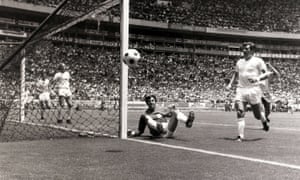
How far might England have gone in that World Cup had Banks been able to play at Léon in the quarter-final against West Germany? Another image emerges: the morning of that match, the lawn in front of the motel where the England team were staying. A pale, unhappy Banks is being helped across the grass on the arm of the England team’s doctor, Neil Phillips. Suffering from food poisoning, Banks was unable to play, and England arguably would have won had he done so. His deputy, Peter Bonetti, was manifestly short of match practice and had a disastrous day. England lost 3-2 and were eliminated.
In later years Banks wondered why it should have been him and no other member of the England squad who contracted a bug. They all, as he said, had eaten exactly the same food. Dark tales have been told of how it may have happened, but the source of the poisoning has never been properly explained.
In the 1966 World Cup, when all England’s games were at Wembley, Banks had played a major part in his country’s success. He kept three clean sheets in the group stage and another against Argentina in the quarter-final, and was only prevented from making it five shut-outs in a row by Eusébio, who thumped home a penalty for Portugal in the semi-final.


No hay comentarios:
Publicar un comentario